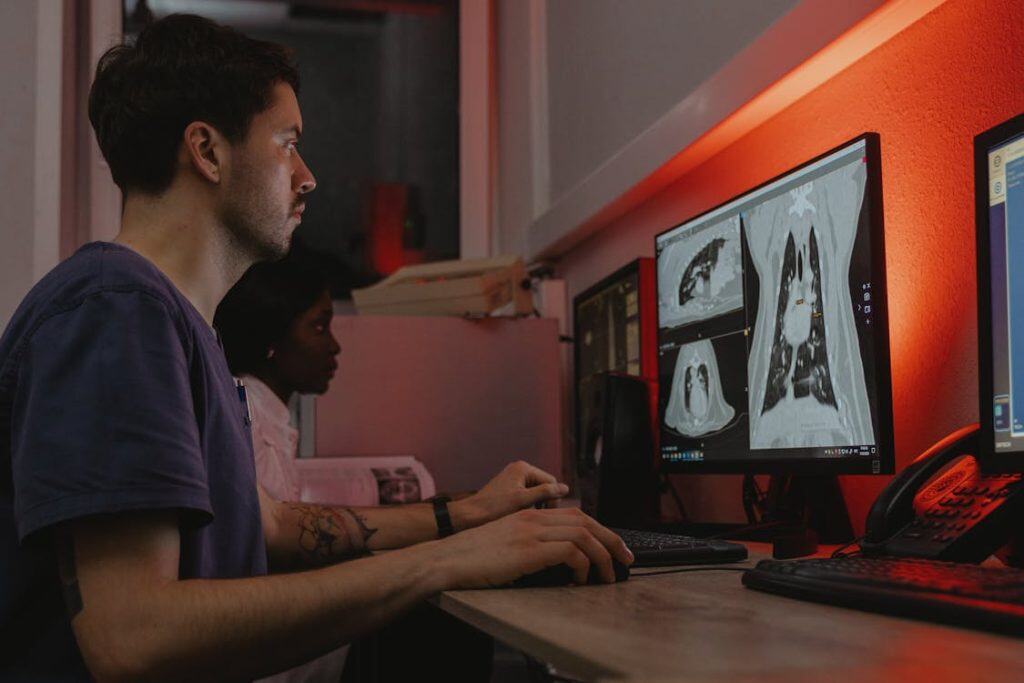
Artificial intelligence is reshaping how imaging centers operate, altering daily routines and targets. Some shifts are subtle while others are plainly visible, touching scheduling, image review and reporting.
Staff often report time savings and a reduction in repetitive tasks, and patients experience faster service. Organizations exploring end-to-end automation for imaging teams often begin by mapping every step from scheduling to final report delivery so that AI tools can support the entire workflow rather than isolated tasks.
AI And Workflow Efficiency
Automation of routine tasks can free radiology technologists to focus on higher value duties and improve patient flow across the department, which often leads to a calmer working day for staff. Intelligent scheduling engines that learn from historical exam lengths, machine availability and staff patterns reduce idle slots and limit backlogs at peak hours.
Rule based routing and priority worklists push urgent cases to the front of the queue and help clinical teams address critical findings with less delay. The overall effect includes improved throughput, better day to day predictability and a clearer set of expectations for both clinicians and administrators.
Image Acquisition And Quality Control
AI driven reconstruction techniques can enhance image clarity from lower dose protocols, offering potential benefits for patient safety while preserving diagnostic information for readers. Automated quality checks detect motion, incomplete coverage or technical artifacts during or immediately after acquisition, so technologists can repeat exams right away when necessary.
That reduction in callbacks and re scans reduces extra cost and lessens patient inconvenience, which also improves resource use. Also, harmonized acquisition parameters across operators create more uniform studies that simplify comparisons over time and aid longitudinal assessment.
Clinical Decision Support And Triage
Decision support systems can flag potential critical findings such as large intracranial bleeds or obstructing lesions, turning a needle in a haystack into an item that draws rapid attention. Automated triage moves suspicious exams to appropriate subspecialty readers and shortens time to possible intervention for life threatening conditions.
There is a trade off between speed and false positives that calls for tuned thresholds, ongoing monitoring and human oversight at key decision points. Radiologists and referral clinicians must work with these tools such that alerts remain helpful rather than distracting, preserving clinical judgment while taking advantage of assistance.
Reporting Speed And Diagnostic Accuracy
Natural language generation can draft preliminary reports by extracting measurements and core observations, which lets radiologists edit and contextualize rather than start from scratch on each study. This practice can cut reporting time, reduce variation in terminology and improve the handoff of information to referring teams and billing departments.
Careful validation remains essential because unwarranted trust in auto generated text could allow errors to persist beneath fluent phrasing. Routine audit cycles and peer review processes catch model drift and other issues, supporting steady diagnostic quality over time.
Patient Experience And Throughput

Predictive scheduling tools estimate how long a given appointment will take with a particular protocol and technologist, which reduces time spent waiting in reception areas and lowers patient frustration.
Chat based virtual assistants can manage routine pre registration questions and deliver clear preparation instructions, leading to fewer missed or incomplete exams and better punctuality for scheduled slots.
Faster intake procedures and fewer unexpected repeats create a smoother visit that is easier for patients to tolerate and for staff to manage. At the same time, maintaining human contact for complex conversations and anxious patients prevents visits from feeling overly mechanized.
Staff Roles Training And Burnout
As repetitive tasks are handled by software, human roles shift toward oversight, communication with patients and handling exceptions that require judgement or manual dexterity. Training programs that combine hands on practice, scenario based exercises and ongoing coaching help staff develop confidence in new workflows and build healthy habits.
Some employees gain relief from tedious duties which reduces stress while others face anxiety about changing responsibilities and potential deskilling that requires honest conversations. Leaders who involve teams early, offer clear career pathways and allocate time for skill building tend to see better adoption and stronger morale.
Financial Impact And Return On Investment
Upfront costs for software licenses, compute infrastructure and systems integration can be significant, making careful budgeting and phased rollouts prudent for many centers. Savings are often realized through fewer repeat scans, shortened report turnarounds, improved scheduling that raises billable throughput and reduced downstream costs linked to missed findings.
A realistic financial model measures time saved per report, changes in exam volume per day and any reductions in revenue loss from diagnostic errors. Models should also account for ongoing expenses such as maintenance, periodic model updates and staff time devoted to monitoring and governance.
Regulatory Ethical And Data Governance
Regulators increasingly ask for transparent performance reports and audit trails that show how algorithm outputs contributed to clinical decisions and which data sets were used for development and validation. Protecting patient privacy requires careful governance of image and metadata, strong encryption, role based access controls and documented retention rules.
Ethical challenges include identifying and correcting bias that produces unequal performance across demographic or clinical subgroups, which calls for broad validation cohorts and open reporting of limitations. Effective governance brings clinicians, IT staff and legal experts together to set policies, approve change requests and monitor compliance on an ongoing basis.
Implementation Challenges And Change Management
Integration with legacy picture archiving and communication systems often requires custom bridging software and careful coordination across vendors, which can lengthen project timetables and test internal capacity.
Pilot deployments that track concrete metrics such as time per exam, error rates and patient throughput help make the case for scale and reveal unanticipated workflow interactions.
Clear escalation pathways, accessible support and iterative adjustments to interfaces and alerts reduce friction and limit lost productivity during transition periods. Teams that share both wins and challenges in straightforward language build trust and keep momentum during the early phases of adoption.
Future Directions In Research And Practice
Ongoing work is evaluating multimodal models that combine images, laboratory data and clinical notes to improve diagnostic context and to generate more useful prognostic information for care teams.
Efforts to create federated learning networks allow centers to train models cooperatively on anonymized data sets without moving raw images, which strengthens validation across diverse populations.
Randomized trials and controlled studies that compare standard workflows to AI supported processes are starting to produce evidence on outcomes such as intervention timing and patient safety. Practitioners who join collaborative research and registry efforts gain early practical lessons that can shape local policy, procurement and clinical practice.